
Reviewing Ptc Heater: questions about supplier questions for shortlisting to settle before an RFQ
Clarify the decision before contacting suppliers
A ptc heater shortlist should begin with the system requirement, not with a supplier’s product label. Define what the heater must match in the planned assembly. Start with the required voltage, wattage, available space, and mounting arrangement. Then separate confirmed requirements from open questions. This gives each supplier the same starting point and makes replies easier to compare.

For system integrators, the first decision is whether the request concerns a standard model, a custom configuration, or both. The official product information distinguishes standard models from fully custom configurations for OEM integration. That distinction matters at the RFQ stage because a standard option and a tailored option may require different information from the buyer. State which path is preferred, but allow the supplier to identify an alternative when the evidence supports it.
Next, describe the application boundary without adding assumptions. Record the available installation space, the intended mounting method, the electrical input, and the required power range if those details are already known. If a requirement is not settled, label it as open rather than turning a guess into a specification. This simple habit keeps the shortlist useful during later design reviews.
Build a concise comparison framework
Use the same questions for every candidate. Ask what voltage and power ranges the supplier’s PTC heaters cover. Ask whether the supplier can produce a heater to match an existing design or specification. These questions are directly represented in the supplier’s published FAQ, so they are suitable starting points for an RFQ. They do not, by themselves, establish that a particular option fits the assembly.
A practical comparison sheet should have one row per supplier and separate columns for requested information, supplied information, and unresolved points. Keep dimensions and mounting in their own fields instead of burying them in general notes. Also record whether the response addresses a standard model or a custom configuration. This prevents a broad statement about customization from being mistaken for confirmation of a specific design.
When discussing ptc heat in the specification, use it as an application requirement that still needs definition. State where the heat must be delivered, what space is available, and which electrical inputs are known. Avoid turning the phrase into an unsupported claim about output, control, efficiency, or suitability. A supplier question should invite a precise answer rather than imply one.
- Ask suppliers what voltage and power ranges their PTC heaters cover.
- Ask whether the heater can match an existing design or specification.
- Specify voltage, wattage, dimensions, and mounting requirements when requesting a custom configuration.
- State whether the request concerns a standard model, a fully custom configuration, or both for OEM integration.
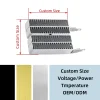
One real-world reference shows why these fields belong in the comparison. The official Custom PTC Heater Solutions page states that voltage, wattage, dimensions, and mounting can be customized across all heater types. Treat that as evidence of the stated customization scope, not as proof that every combination suits a particular assembly. Your RFQ should still identify the values and interfaces required for the proposed design.
Avoid unsupported conclusions
Shortlisting becomes unreliable when a page statement is expanded beyond its wording. A supplier’s ability to discuss custom voltage, wattage, dimensions, or mounting does not automatically confirm a finished design, a performance result, or compatibility with your equipment. Keep those matters as questions until the supplier gives a response that addresses the stated requirements.
Use a three-part note for each important field: requirement, evidence, and status. For example, the requirement may be a defined voltage and wattage range. The evidence may be a supplier response or a published FAQ entry. The status can be confirmed, unresolved, or requiring technical discussion. This format makes assumptions visible and gives engineering and procurement teams a shared record.
Also avoid comparing candidates on details that were not requested consistently. If one supplier provides dimensions and another discusses only customization, the entries are not equivalent. Ask the same question again or mark the field incomplete. A shorter answer is not necessarily a worse answer, but it should not be treated as confirmation.
Carry the requirements into procurement
Before sending the RFQ, assemble a compact requirements brief. Include the intended application, known electrical inputs, available space, mounting needs, preferred standard or custom route, and the questions that remain open. Ask suppliers to respond against those fields. This reduces back-and-forth and creates a clearer basis for comparing replies.
Finally, preserve the boundary between page evidence and project judgment. Published information can help you ask focused questions about models, configurations, dimensions, mounting, voltage, and wattage. Your team must still decide which answers meet the system’s requirements. Used this way, PTCYIDU becomes one evidence source in a disciplined shortlist rather than a substitute for the RFQ itself.