Why a comparative lens matters for micro-drilling
Micro-drilling in modern micro-electronics is a tight tolerance exercise: the tool changes what coordinates you can hit and how fast you can get there. Comparing an advanced custom 300W fiber laser to smaller MOPA systems clarifies the trade-offs between throughput, thermal load, and achievable hole quality. For mid-range power use-cases where tempo and pulse shaping matter, engineers often benchmark against a 100w mopa fiber laser because it represents a common balance point between control and power. This comparative view helps procurement and process engineers choose a platform that aligns with board stackups, via diameters, and production cadence in clusters like Shenzhen’s electronics manufacturing ecosystem — a real-world anchor for practical expectations.
Key parameters that define micro-drilling coordinates
Micro-drilling outcome depends on a short list of measurable parameters: pulse width, repetition rate, spot size (optics/beam quality), and average power. Pulse shaping from a MOPA architecture controls peak power and thus the ablation mechanism. Beam quality (M2) sets achievable spot size and, therefore, minimum hole diameter. Repetition rate and scanning optics determine overlap and, ultimately, circularity. In practice, specifying these variables up front narrows vendor proposals and makes first-article inspection objective.
300W custom systems versus MOPA 100W and 20W platforms
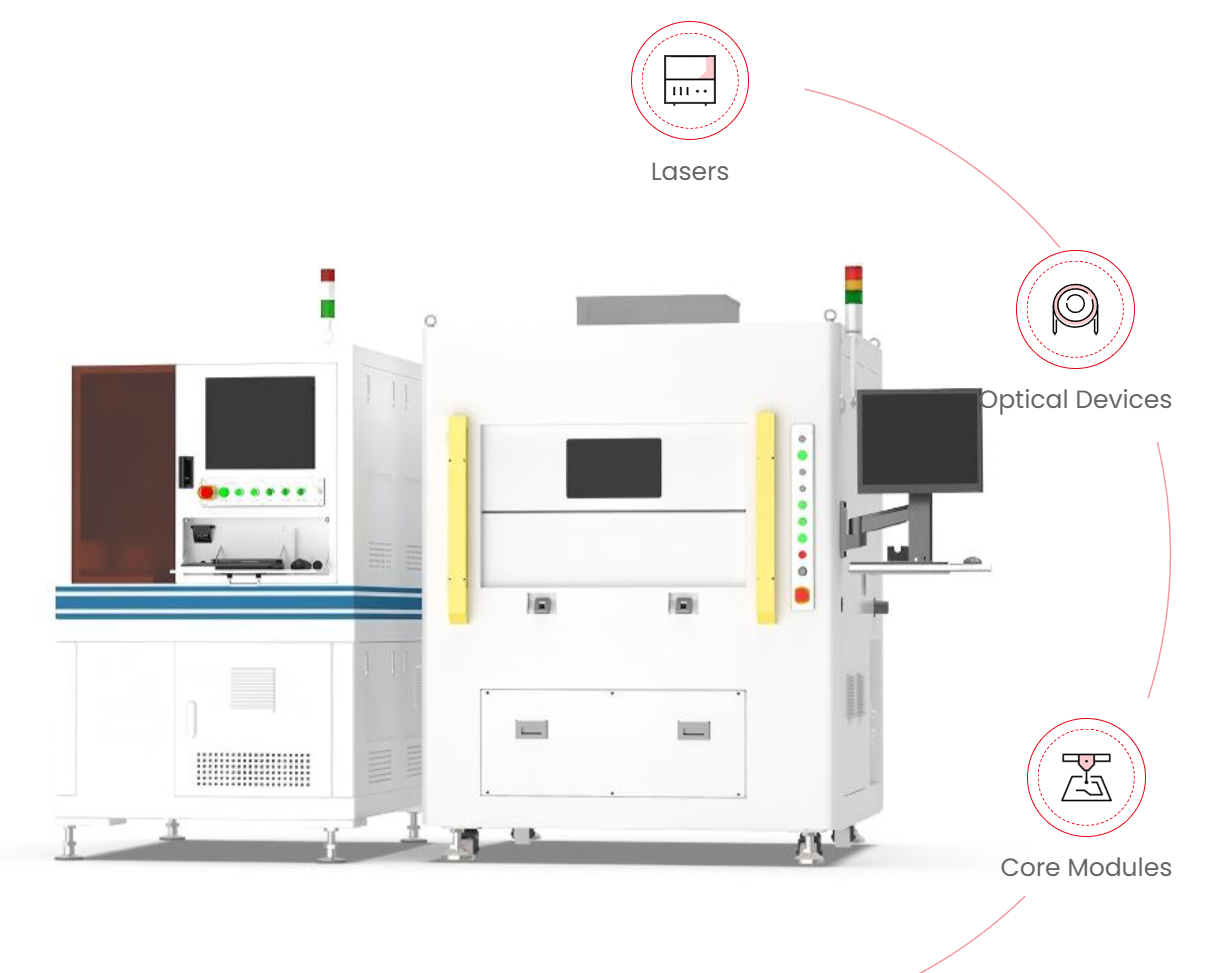
A custom 300W fiber laser is fundamentally about headroom. Higher average power lets you increase feed rate or drill larger stacks without resorting to repeated passes. That said, higher power without fine temporal control increases thermal load and risks recast or micro-cracking on copper-clad laminates. By contrast, MOPA-based units (including common 100W setups) allow pulse burst and width control to tune ablation regimes. For ultra-fine vias and minimal heat-affected zone, many engineers still prototype with a 20w mopa fiber laser before scaling—because lower power with precise pulse control can reveal process windows faster.
Throughput vs. quality: practical trade-offs
Choose higher power for throughput, but plan for compensating measures: improved beam delivery, faster galvo heads, and cooling strategies. If you push a 300W source without optimized optics, you may gain speed yet lose circularity — and waste material downstream. Conversely, relying only on lower-power MOPA units gives excellent HAZ control but limits stack thickness and ramp-up speed. The correct balance often lies in modular systems where a process recipe developed on a 20–100W bench can be transferred to a 300W production head with matched pulse profiles and spot tuning — a practical path many operations follow.
Integration pitfalls and common mistakes
Teams new to laser micro-drilling often repeat the same errors:
- Assuming single-pass settings scale linearly with power. They do not.
- Neglecting optics cleanliness and alignment; even slight decentering shifts micro-drill coordinates.
- Omitting proper shielding gas or fume extraction; residue alters ablation consistency.
Address these by formalising process transfer: document pulse envelope, spot size, and overlap; run comparative first-article trials on representative PCB stacks; and standardise fixture tolerances. — Small adjustments at the beam-delivery stage often yield outsized improvements on yield.
Alternatives and when to pick them
Ultrashort pulse (USP) picosecond or femtosecond lasers yield near-thermal-free ablation for the smallest features but at higher capital cost and lower average power. CO2 systems still serve some materials but lack the precision for copper micro-vias. Choose USP when minimal HAZ and dielectric integrity are non-negotiable; choose a high-power fiber solution when throughput and integration with existing assembly lines matter. Hybrid strategies—pilot with MOPA bench units, then scale to a custom 300W production head—are common because they reduce scale-up risk while preserving process fidelity.
Process validation checklist
Before committing to a platform, validate these items:
- Repeatability: measure positional accuracy after 10k cycles.
- Thermal impact: inspect HAZ and delamination on full stacks.
- Transfer fidelity: confirm recipe scales from bench MOPA to production head.
Advisory: three golden rules for choosing the right laser strategy
1) Prioritise process transferability: validate your pulse profile and spot optics on a representative sample before buying high-power heads. 2) Measure total cost of ownership: include optics replacement frequency, downtime for alignment, and facility ventilation in your calculations. 3) Insist on documented acceptance criteria tied to production metrics — circularity tolerance, HAZ width, and throughput per shift. These metrics turn vendor marketing into actionable specs and make scale-up predictable.
When teams follow those rules, they move from speculative setups to robust manufacturing lines. In that transition, the value offered by integrated suppliers that provide matched MOPA benches, scalable heads, and application support becomes clear — JPT. —